
How I navigate London without a smartphone
I’m late a lot

One of the biggest questions I had before switching to a dumbphone was: how will I get around? I had spent years compulsively plugging every destination into Google Maps. Even if I’d been there dozens of times before! (What if there was a better route? What if the train wasn’t running? What if I suddenly forgot the route from my house to the coffee shop where I had a full punch card?) It felt daunting — maybe even a little unsafe — to attempt to get around without GPS assistance.
Well, surprise: once I looked up from my phone, I found a city designed to be explored. There are maps everywhere. The train lines don’t move. There’s a big river running through the middle and if I know nothing else, I know whether I need to be north or south of it.
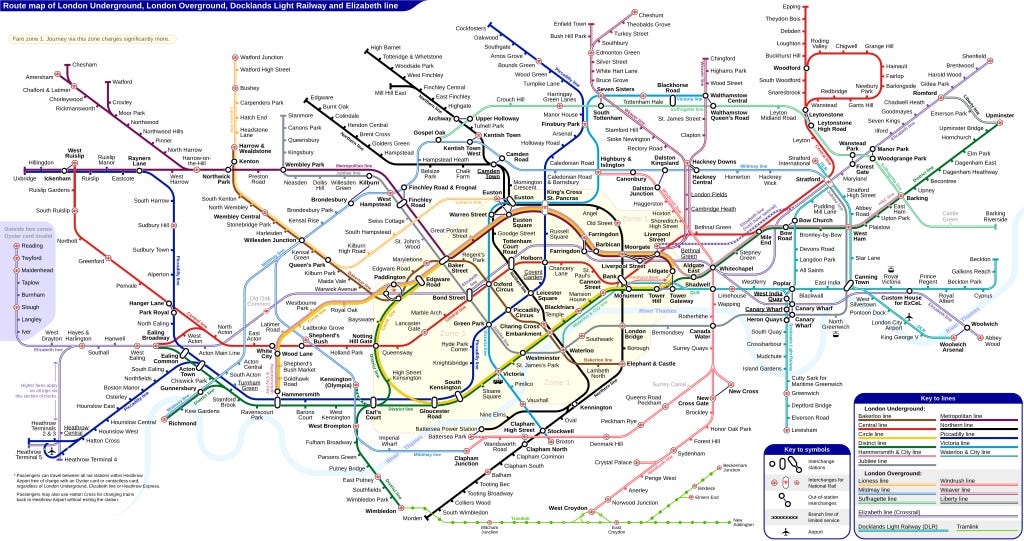
This is how I navigate London without a smartphone.
1. Google Maps for KaiOS
Before I wax poetic about the beauty of analog navigation, let me clear something up: many (most?) dumbphones are smart enough for GPS. My Nokia 2780 comes pre-installed with a version of Google Maps designed for KaiOS, a clunky feature phone operating system.
Google Maps for KaiOS is not the seamless experience a smartphone user will be used to. Typing out place names on a T9 keyboard takes a long time. There is no orientation: to figure out whether you’re pointing the right direction, you have to look at street signs and think. The app will refuse to open for days at a time, returning at random (or, often, shortly after I really could have used it).
It’s still a miracle: the culmination of decades of technological achievement, available on my cheap little phone, to get me from point A to point B. And I do use it. I just don’t rely on it like I used to.
2. DIY directions
When I plan to visit somewhere new, I write or draw directions beforehand. (This brings back childhood memories of my parents printing off Mapquest directions, smoothing them to the dashboard of the car.) I pay most attention to the end of the journey, after exiting the bus or train or underground station, when every little landmark counts. This process, like taking notes, cements the knowledge in my mind even if I never refer back to it.
3. Maps
London is covered in maps: tube maps, bus routes, tall plastic steles next to e-bike docking stations. Once, I peeked into the window of a tat shop to get a closer look at a map-printed mug. (It actually helped.) I’m never so lost that I can’t make it to one map or another.
4. Memory
Black cab drivers’ brains expand to fit The Knowledge of every street in London.
I’d like to think mine is expanding too. Slowly. Modestly. (I live on the corner of a side street and a main road: the name of this main road was, until quite recently, unknown to me.) It’s a little easier to acquire spatial awareness of the Thames. I live south of it. Most things are north of it. This helps, in a ‘this way is up’ sort of way.
4. Temporal flexibility
I’m making this all sound very nice and easy, isn’t it? Important caveat: I’m late a lot.
Example 1: I meet a friend in Southeast London. I remember there is a tram stop nearby. I look at a map and see how to get to the tram. I do so. I do not realize until it’s too late that this is a 90-minute route.
Example 2: I meet a friend in Southeast London. I remember it took too long on the tram. I attempt to take the District Line to Victoria. But the line is out of service — which I would have known, had I looked it up on my phone.
In exchange for an efficient route and clear estimated-time-of-arrival, I get to know my city better, to learn how one street flows into another. In my opinion, the trade-off is worth it. (My friend might disagree. Sorry, I’ll leave earlier next time!)
Love this!!
Get around Philly with no phone at all most of the time. Pretty easy if you write directions down, become familiar with the trains and ask people. Friends in NYC have bike maps that I'll use when I'm there.